Recycling and Sustainability — Commercial Waste Fitzrovia
 Commercial Waste Fitzrovia is committed to creating an eco-friendly waste disposal area and a truly sustainable rubbish area for businesses across Fitzrovia. Our approach balances practical commercial waste collection with ambitious environmental goals: reducing landfill, increasing material recovery and supporting local reuse. This page explains our targets, how we work with borough partners, the transfer stations we use, charity partnerships and the low-carbon vans that do the rounds in the neighbourhood.
Recycling percentage target and measurable goals
We have set a clear recycling percentage target: to achieve a 70% recycling rate by 2030 across all Fitzrovia commercial waste streams. This target covers dry mixed recycling, food and organic waste, bulky reuseables and construction waste where relevant. To reach this goal we monitor performance metrics monthly and publish aggregated progress reports to demonstrate how the eco-friendly waste disposal area is evolving. How the local boroughs approach waste separation: Camden and the City of Westminster promote kerbside recycling systems that include separate food waste collections, communal glass and bottle banks, plus mixed recycling pickups for cardboard, paper and plastics. In line with borough strategies we encourage premises to separate food waste at source, use clearly labelled bins for recyclable materials and reduce contamination. Key local recycling activities include:
- Kerbside and communal separation for paper, card, plastic and glass to match borough collections;
- Food and organic collection for restaurants, cafes and catering venues to divert organics to composting or anaerobic digestion;
- Bulky and WEEE recycling for furniture and electricals through specialist streams that prioritise reuse.
Local transfer stations and processing hubs
We work with a network of nearby transfer stations and Materials Recovery Facilities (MRFs) across central London to ensure collected commercial waste is handled efficiently. These local transfer stations act as consolidation points where materials are weighed, quality-checked and sent to the right processing route—recycling, composting, repair or material recovery. By using transfer stations close to Fitzrovia we reduce haulage mileage and support a low-carbon logistics chain.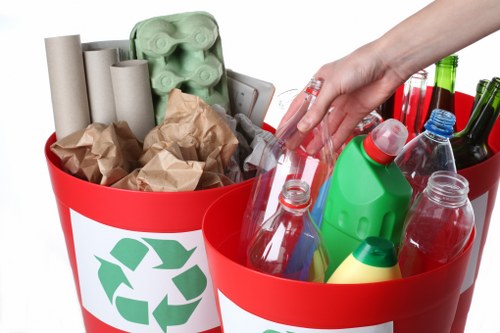 Partnerships with charities and social enterprises are central to our sustainable rubbish area strategy. Reuse is higher value than raw recycling, so we prioritise donation channels for items like office furniture, fixtures, surplus textiles and working electronics. We coordinate with local reuse centres, community groups and registered charities to:
- redirect good-quality desks, chairs and shelving for community projects;
- pass working IT equipment to training programmes;
- ensure textiles and clothing are repaired or redistributed rather than shredded.
Low-carbon vans and greener collection fleets are a visible part of our sustainability promise. Our Fitzrovia routes increasingly use electric and plug-in hybrid vans to cut emissions in dense urban streets. Route optimisation software, combined with scheduled consolidation points at transfer stations, reduces vehicle miles travelled and idling time. We also operate a maintenance and driver training programme to promote eco-driving habits, lowering fuel consumption and noise pollution in the neighbourhood.
 Operational practices for an effective eco-friendly waste disposal area include segregation at source, clear bin labelling, and on-site audits for contamination. For construction or refurbishment projects we offer dedicated skips and sorting crews that separate plasterboard, timber, metals and aggregates so valuable materials can be recovered rather than landfilled. Our approach to the sustainable rubbish area emphasises prevention first, then reuse, then recycling—following circular economy principles.
 Measurement, reporting and continuous improvement: achieving a 70% recovery rate requires transparent data. We deliver monthly diversion summaries to clients, showing tonnages by stream, contamination levels and carbon savings from low-carbon van use. Where targets are not met we implement corrective action plans—additional staff training, new bin signage, or closer charity pickup coordination—to drive steady improvement.
Practical steps for businesses in Fitzrovia: to support the broader borough approach and our commercial waste Fitzrovia service, businesses should segregate waste at the point of generation, reduce packaging, and identify items suitable for donation. Engagement with staff and contractors is essential: clear, simple instructions increase participation in recycling programmes and reduce cleaning and disposal costs.
Collaboration across local stakeholders—from building managers and small retailers to larger employers—creates a resilient, sustainable rubbish area that benefits everyone. We actively collaborate with borough recycling initiatives, local transfer stations and charitable partners to make sure materials collected in Fitzrovia are treated ethically and effectively.
In summary, our Fitzrovia commercial waste services focus on building an eco-friendly waste disposal area underpinned by a 70% recycling percentage target, smart use of local transfer stations, strong charity partnerships and a modern low-carbon van fleet. Together these measures create a practical, measurable and community-minded route to a cleaner, greener Fitzrovia.
